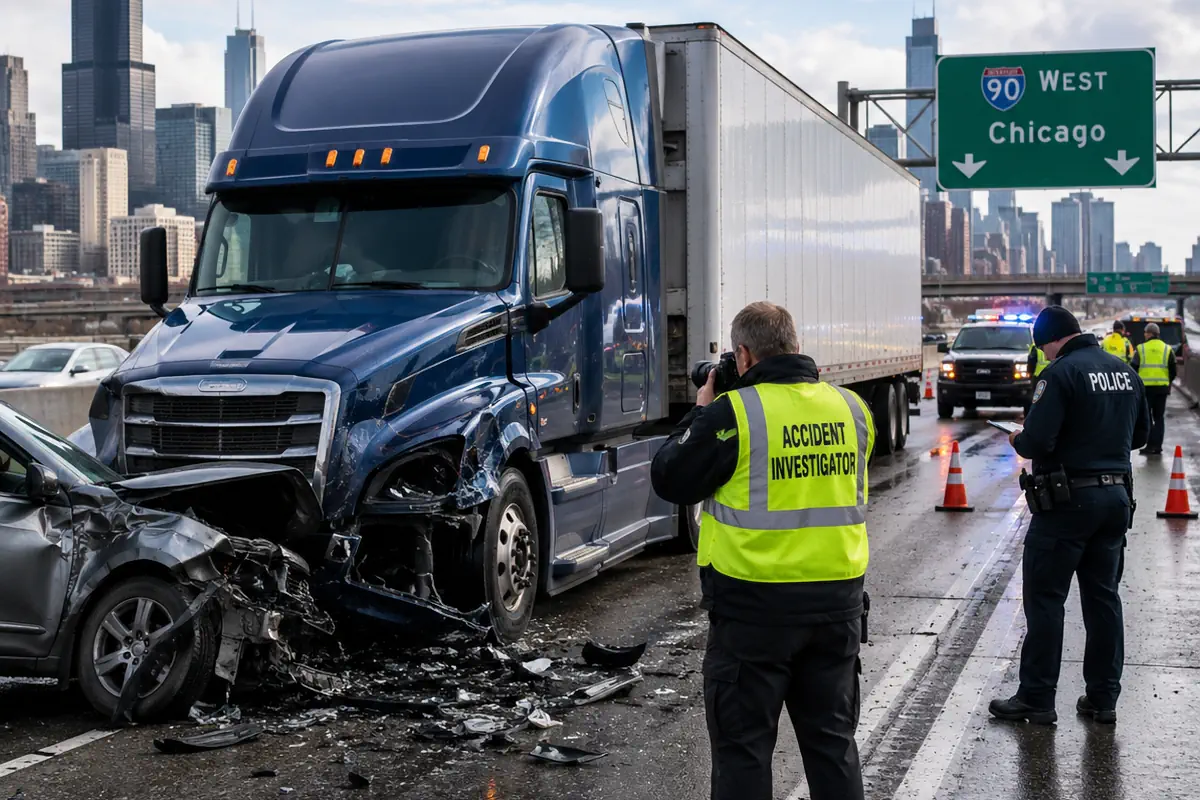
Ley de Accidentes de Camiones y Reclamos por Lesiones Graves en Illinois
Truck Accident Cases in Illinois
Truck accident cases are often more complex than ordinary car accident claims. A collision involving a commercial truck can cause severe injuries, long recovery periods, financial stress, and disputes over responsibility.
Large commercial vehicles operate differently from passenger cars. They weigh more. They require longer stopping distances. They may carry cargo that changes vehicle balance and braking performance. Because of these factors, injuries in truck crashes are often serious.
Truck Accident Law involves many legal issues, including:
- Driver negligence
- Company responsibility
- Vehicle maintenance records
- Cargo loading practices
- Insurance disputes
- Federal transportation rules
- Evidence preservation
- Injury damages
Many victims are surprised to learn that more than one party may be responsible after a truck collision.
A truck accident investigation may involve:
- The truck driver
- The trucking company
- A cargo company
- A maintenance contractor
- A vehicle manufacturer
- Insurance carriers
The legal process may become complicated quickly, especially when multiple companies attempt to shift blame.
People injured in truck crashes often face:
- Emergency medical bills
- Lost wages
- Physical pain
- Rehabilitation expenses
- Emotional distress
- Long-term disability
- Property damage
Truck accident claims can involve extensive documentation and evidence review.
Why Truck Accidents Are Different
Commercial trucks create different risks compared to smaller vehicles.
A fully loaded tractor-trailer may weigh many times more than a passenger car. Because of this size difference, even low-speed crashes may cause major injuries.
Truck accidents may involve:
- Jackknife collisions
- Underride accidents
- Blind spot crashes
- Rear-end impacts
- Wide-turn collisions
- Tire blowouts
- Cargo spills
- Multi-vehicle highway crashes
Certain roads around the Chicago area experience heavy commercial traffic. Congested highways and changing weather conditions may increase collision risks.
Truck accident investigations often focus on whether safety procedures were followed before the crash occurred.
Important evidence may include:
- Driver logs
- GPS data
- Dash camera footage
- Electronic logging device records
- Maintenance reports
- Inspection records
- Toxicology reports
- Dispatch communications
Without quick action, some records may disappear or become harder to obtain.
Common Causes of Truck Collisions
Truck crashes may happen for many reasons. In some situations, more than one factor contributes to the collision.
Driver Fatigue

Fatigue remains a major concern in the trucking industry.
Long driving hours may reduce reaction time and judgment. A tired driver may fail to brake properly or notice traffic changes.
Signs of fatigue-related driving may include:
- Lane drifting
- Delayed braking
- Sudden swerving
- Inconsistent speed
- Missed traffic signals
Electronic driving logs may become important evidence in these cases.
Distracted Driving
Truck drivers may become distracted by:
- Mobile phones
- Navigation systems
- Dispatch devices
- Food or drinks
- Paperwork
Even a brief distraction may lead to catastrophic injuries when large commercial vehicles are involved.
Speeding
Commercial trucks require longer stopping distances.
A speeding truck may become difficult to control during:
- Heavy traffic
- Rainstorms
- Sharp turns
- Construction zones
Speed-related crashes often produce severe impact forces.
Improper Maintenance
Trucking companies may have responsibilities involving vehicle inspection and maintenance.
Mechanical failures may involve:
- Brake problems
- Tire defects
- Steering issues
- Lighting failures
- Trailer connection defects
Maintenance records may become central evidence during a legal claim.
Improper Cargo Loading
Improperly loaded cargo may affect truck stability.
Cargo problems may lead to:
- Rollovers
- Jackknife accidents
- Shifting loads
- Falling debris
Cargo loading companies may sometimes share legal responsibility.
Injuries Commonly Seen in Truck Accident Claims
Truck collisions may produce life-changing injuries.
Some victims require months or years of medical care.
Common injuries include:
- Traumatic brain injuries
- Spinal cord injuries
- Neck injuries
- Back injuries
- Internal bleeding
- Broken bones
- Crush injuries
- Burns
- Permanent disability
Emotional injuries may also occur after severe collisions.
Some people experience:
- Anxiety
- Depression
- Driving fear
- Sleep disturbances
- Emotional trauma
Medical documentation often becomes critical in proving damages.
What Victims Should Do After a Truck Accident
The moments after a truck collision can affect both health and future legal claims.
Safety should always come first.
Seek Medical Attention
Even injuries that appear minor may become serious later.
Medical records may also help connect injuries to the crash.
Delaying treatment may create disputes during an insurance claim.
Preserve Evidence
If possible, individuals may wish to preserve:
- Photos of vehicles
- Road conditions
- Injuries
- Skid marks
- Traffic signs
Witness information may also become important later.
Avoid Admitting Fault
Statements made at the scene may later be used by insurance companies.
People should avoid speculation about what caused the collision.
Report the Crash
Police reports may become valuable evidence.
A report may contain:
- Driver information
- Witness statements
- Initial observations
- Weather conditions
- Road conditions
Be Careful With Insurance Statements
Insurance companies may contact victims quickly after a crash.
Recorded statements may affect future claims.
People should understand what information they are providing before speaking extensively about injuries or fault.
Trucking Companies and Liability Issues
Truck accident cases often involve corporate defendants.
Trucking companies may attempt to reduce legal exposure after a serious crash.
Liability issues may involve:
- Hiring practices
- Driver training
- Safety monitoring
- Maintenance procedures
- Hours-of-service compliance
Company records may reveal whether proper safety measures were followed.
Some cases involve allegations that companies ignored warning signs involving unsafe drivers or unsafe vehicles.
Federal and State Transportation Rules
Trucking operations may be affected by federal and state transportation regulations.
These rules may address:
- Driver qualification standards
- Vehicle inspections
- Weight limits
- Hours of service
- Recordkeeping requirements
Violations may become relevant evidence during litigation.
However, every case is different. A regulatory violation does not automatically determine legal liability.
Federal Motor Carrier Safety Administration
Insurance Challenges in Truck Accident Cases
Insurance disputes are common after commercial truck crashes.
Truck accident claims may involve large insurance policies and aggressive defense strategies.
Insurance companies may dispute:
- Medical treatment
- Injury severity
- Lost income
- Future damages
- Fault percentages
Victims may face pressure to settle claims quickly.
Early settlement offers may not fully account for long-term medical needs or future financial losses.
Evidence That May Strengthen a Truck Accident Claim
Truck accident claims often depend heavily on evidence.
Important evidence may include:
- Medical records
- Black box data
- Witness statements
- Crash reconstruction analysis
- Video footage
- Cell phone records
- Employment files
- Inspection reports
Some evidence may only remain available for a limited period of time.
Preservation requests may become important in serious injury litigation.
Comparative Fault Issues
Illinois injury claims may involve comparative fault arguments.
Insurance companies may attempt to argue that another driver partially caused the crash.
Examples may include allegations involving:
- Unsafe lane changes
- Speeding
- Distracted driving
- Failure to yield
Comparative fault disputes may affect compensation calculations.
These cases often require careful investigation and evidence analysis.
Damages in Truck Accident Cases
Truck accident victims may pursue compensation for various losses depending on the facts of the case.
Potential damages may include:
- Medical expenses
- Future medical care
- Lost wages
- Reduced earning capacity
- Pain and suffering
- Emotional distress
- Disability-related costs
- Rehabilitation expenses
In severe injury cases, long-term care planning may become necessary.
Wrongful Death Claims
Some truck accidents result in fatal injuries.
Families may face emotional and financial hardship after losing a loved one in a commercial truck crash.
Wrongful death claims may involve damages related to:
- Funeral expenses
- Loss of financial support
- Loss of companionship
- Medical expenses before death
These cases are often emotionally difficult and legally complex.
Serious commercial vehicle collisions may also involve evolving litigation strategies and changing insurance claim patterns. Readers interested in broader injury claim developments may also review our discussion about Chicago personal injury case trends and how complex injury disputes continue to change in Illinois.
Road Conditions and Weather Factors
Illinois weather conditions may contribute to truck crashes.
Commercial vehicles may become harder to control during:
- Snow
- Ice
- Heavy rain
- Fog
- High winds
Poor road visibility and slippery pavement may increase stopping distances.
Truck drivers and trucking companies may still have responsibilities to operate safely during dangerous weather conditions.
Construction Zones and Commercial Trucks
Construction areas often create additional risks for large trucks.
Lane changes, narrowed roads, sudden traffic slowdowns, and temporary barriers may increase collision risks.
Construction zone truck accidents may involve:
- Rear-end crashes
- Side-swipe collisions
- Merging accidents
- Debris-related crashes
Drivers operating commercial vehicles in construction areas may need additional caution because stopping distances can increase significantly.
Electronic Data in Truck Accident Investigations
Modern commercial trucks may store important electronic data.
This information may help investigators understand what happened before a crash.
Electronic evidence may include:
- Vehicle speed
- Brake usage
- Steering activity
- GPS tracking
- Driving hours
- Sudden deceleration data
Preserving electronic records quickly may become important after serious truck collisions.
Truck Driver Qualification Issues
Commercial truck drivers may need specific licenses and training.
Investigations sometimes examine whether a driver had:
- Proper licensing
- Adequate training
- A history of violations
- Prior safety incidents
- Medical clearance requirements
Driver qualification records may become part of litigation involving commercial trucking companies.
Medical Documentation and Injury Evidence
Medical documentation may play a major role in truck accident injury claims.
Insurance companies often examine whether records clearly connect injuries to the collision.
Helpful documentation may include:
- Emergency room records
- Imaging studies
- Surgical reports
- Rehabilitation records
- Prescription history
- Physical therapy documentation
- Physician recommendations
Consistent treatment records may help demonstrate the seriousness of injuries.
Gaps in treatment may sometimes become disputed during litigation.
Long-Term Financial Impact
Truck accident injuries may affect a person’s financial stability for years.
Some victims cannot immediately return to work. Others may permanently lose earning capacity.
Long-term financial effects may include:
- Ongoing medical expenses
- Reduced work hours
- Career changes
- Disability accommodations
- Home modification costs
- Transportation expenses
Serious injury claims may require evaluations from medical and economic experts.
Truck Accident Investigations
Truck accident investigations may involve several steps.
Investigators may review:
- Crash scene photographs
- Vehicle damage
- Black box information
- Surveillance footage
- Witness interviews
- Police findings
- Driver qualification files
In some cases, accident reconstruction experts may analyze how the collision occurred.
These investigations may become especially important when liability is disputed.
Semi-Truck Blind Spots
Commercial trucks have larger blind spots than ordinary passenger vehicles.
Blind spots may exist:
- Directly behind the trailer
- Along both sides of the truck
- Near the front of the cab
Blind spot crashes may happen when smaller vehicles remain unseen during lane changes or turns.
Truck drivers still have responsibilities to monitor traffic carefully before changing lanes or making wide turns.
Highway Truck Crashes
Highway truck collisions may involve high-speed impacts and multiple vehicles.
Interstate crashes may create dangerous chain-reaction collisions.
Factors sometimes involved include:
- Sudden traffic stops
- Driver fatigue
- Weather conditions
- Speeding
- Unsafe following distances
Multi-vehicle crashes often require extensive investigation because responsibility may be disputed among several parties.
Underride and Override Collisions
Certain truck crashes may involve underride or override events.
An underride collision may occur when a smaller vehicle slides underneath a trailer.
An override collision may occur when a truck drives over a smaller vehicle during impact.
These accidents often result in catastrophic injuries or fatalities.
Investigations may examine whether safety guards and vehicle equipment met applicable standards.
Delivery Trucks and Local Commercial Vehicles
Truck accident claims are not limited to interstate semi-trucks.
Commercial vehicle cases may also involve:
- Delivery vans
- Box trucks
- Utility vehicles
- Garbage trucks
- Construction trucks
- Moving trucks
Local delivery traffic has increased in many urban areas.
Busy streets, tight turns, and frequent stops may increase collision risks involving commercial delivery vehicles.
Pedestrian and Bicycle Accidents
Commercial trucks may create additional dangers for pedestrians and bicyclists.
Large vehicles may have wider turning areas and larger blind spots.
Urban truck collisions involving pedestrians or cyclists may happen near:
- Intersections
- Crosswalks
- Loading zones
- Construction areas
Serious injuries may occur even at lower speeds because of vehicle size and weight.
Evidence Preservation Concerns
Important evidence may disappear quickly after a truck collision.
Companies may repair vehicles or overwrite electronic data if preservation steps are not taken promptly.
Evidence preservation may involve:
- Retaining vehicle inspection records
- Preserving black box data
- Securing video footage
- Protecting maintenance records
Timely investigation may become important in serious injury claims.
Settlement Negotiations
Many truck accident claims involve settlement discussions.
Insurance carriers may evaluate:
- Medical expenses
- Future treatment needs
- Liability evidence
- Lost income
- Long-term disability
Settlement negotiations may become complicated when injuries are severe or permanent.
Victims should understand the possible long-term impact of injuries before accepting compensation offers.
Litigation in Truck Accident Cases
Some truck accident disputes may proceed into litigation.
Court proceedings may involve:
- Discovery requests
- Depositions
- Expert testimony
- Medical evaluations
- Motion hearings
Litigation timelines vary depending on case complexity and disputed issues.
Complex commercial trucking cases may involve substantial documentation and technical evidence.
Rules of the Road and Traffic Safety Publications and Forms
Social Media and Injury Claims
Insurance companies may review social media activity during injury claims.
Posts, photos, videos, or public comments may later become evidence.
People involved in truck accident claims may wish to use caution when discussing:
- Injuries
- Physical activity
- Travel
- Employment
- Settlement discussions
Even unrelated posts may sometimes be interpreted differently during litigation.
Commercial Insurance Policies
Commercial trucking policies may differ from ordinary auto insurance coverage.
Truck accident cases may involve:
- Primary commercial coverage
- Umbrella policies
- Cargo insurance
- Employer liability policies
Insurance coverage disputes sometimes arise regarding:
- Coverage limits
- Exclusions
- Independent contractor relationships
- Multiple responsible parties
Understanding available insurance coverage may become important in catastrophic injury cases.
Catastrophic Injuries and Life Care Planning
Some truck accidents result in catastrophic injuries requiring lifelong care.
These cases may involve:
- Permanent paralysis
- Brain injuries
- Severe burns
- Amputations
- Cognitive impairment
Long-term planning may require evaluation of:
- Medical treatment costs
- Rehabilitation expenses
- Future surgeries
- Home care needs
- Assistive equipment
Life care plans may help estimate future damages in severe injury litigation.
Family Impact After Serious Truck Accidents
Truck collisions may affect entire families.
Family members may experience:
- Financial stress
- Emotional trauma
- Caregiving responsibilities
- Loss of household income
Serious injuries may change family routines and long-term planning.
Legal claims sometimes include damages related to emotional and relational losses depending on the facts involved.
Choosing Legal Representation After a Truck Accident
Truck accident litigation may involve complicated factual and legal issues.
People evaluating legal representation may consider factors such as:
- Experience with commercial vehicle cases
- Trial experience
- Investigation resources
- Knowledge of trucking regulations
- Communication practices
Every case is different, and outcomes depend on many factors.
FAQ — Truck Accident Law
What makes truck accident cases different from car accident cases?
Truck accident cases often involve larger insurance policies, commercial companies, electronic driving records, and federal transportation regulations. Injuries are also frequently more severe because of the size and weight of commercial trucks.
Who may be responsible after a truck accident?
Liability may involve multiple parties, including the truck driver, trucking company, maintenance contractors, cargo loading companies, or vehicle manufacturers.
What evidence is important after a truck crash?
Important evidence may include medical records, photographs, witness statements, police reports, black box data, maintenance records, and electronic driving logs.
Can weather conditions affect truck accident claims?
Yes. Weather conditions may contribute to crashes, but drivers and trucking companies may still have responsibilities to operate safely during dangerous conditions.
What injuries are common in truck accident cases?
Common injuries include traumatic brain injuries, spinal cord injuries, fractures, burns, internal injuries, and permanent disabilities.
Why is quick investigation important after a truck accident?
Important evidence such as electronic records, surveillance footage, and maintenance documents may disappear or be overwritten if not preserved quickly.
Can social media affect a truck accident injury claim?
Yes. Insurance companies may review social media posts and photos during injury investigations and litigation.
Are truck accident settlements usually larger than car accident settlements?
Truck accident claims may involve larger damages because injuries are often more severe and commercial insurance policies may have higher coverage limits. However, every case is different.
Legal Disclaimer
THIS ARTICLE IS PROVIDED FOR GENERAL INFORMATIONAL PURPOSES ONLY AND DOES NOT CONSTITUTE LEGAL ADVICE. READING THIS CONTENT DOES NOT CREATE AN ATTORNEY–CLIENT RELATIONSHIP BETWEEN THE READER AND SERVICIOS LEGALES ABOGADOS CHICAGO OR ANY OF ITS ATTORNEYS.
TRUCK ACCIDENT LAW, PERSONAL INJURY LAW, INSURANCE RULES, AND RELATED LEGAL MATTERS ARE HIGHLY FACT-SPECIFIC AND MAY CHANGE OVER TIME DUE TO NEW LEGISLATION, COURT DECISIONS, REGULATORY CHANGES, OR OTHER LEGAL DEVELOPMENTS. EVERY CASE IS DIFFERENT, AND PAST RESULTS DO NOT GUARANTEE FUTURE OUTCOMES.
WHILE EFFORTS ARE MADE TO PROVIDE ACCURATE AND CURRENT INFORMATION, NO GUARANTEE IS MADE REGARDING THE COMPLETENESS, ACCURACY, RELIABILITY, OR TIMELINESS OF THE INFORMATION CONTAINED IN THIS ARTICLE. SERVICIOS LEGALES ABOGADOS CHICAGO IS NOT RESPONSIBLE FOR INACCURACIES, OMISSIONS, TYPOGRAPHICAL ERRORS, OR OUTDATED INFORMATION.
READERS SHOULD NOT ACT OR REFRAIN FROM ACTING BASED SOLELY ON THE CONTENT OF THIS ARTICLE. LEGAL ISSUES SHOULD BE EVALUATED BY A LICENSED ATTORNEY WHO CAN REVIEW THE SPECIFIC FACTS AND CIRCUMSTANCES OF AN INDIVIDUAL MATTER.
THIS CONTENT MAY DISCUSS LEGAL PRINCIPLES, PROCEDURES, OR GENERAL CLAIM ISSUES, BUT IT DOES NOT SUBSTITUTE FOR INDIVIDUALIZED LEGAL GUIDANCE.
If you or a loved one has been affected by a commercial truck accident in Illinois, Servicios Legales Abogados Chicago may be able to help you better understand your legal options, injury claims, and insurance-related concerns.